Commercial
Per-Fixture Lighting Retrofits: What Bulk LED and Fixture Replacement Costs in Metro Vancouver
When a project has 12 fixtures or 400, per-fixture pricing is the fairest and most predictable way to buy lighting work. Here is how unit pricing is built, what drives the number up or down, and how Metro Vancouver property managers, stratas, and homeowners should budget a bulk lighting retrofit.
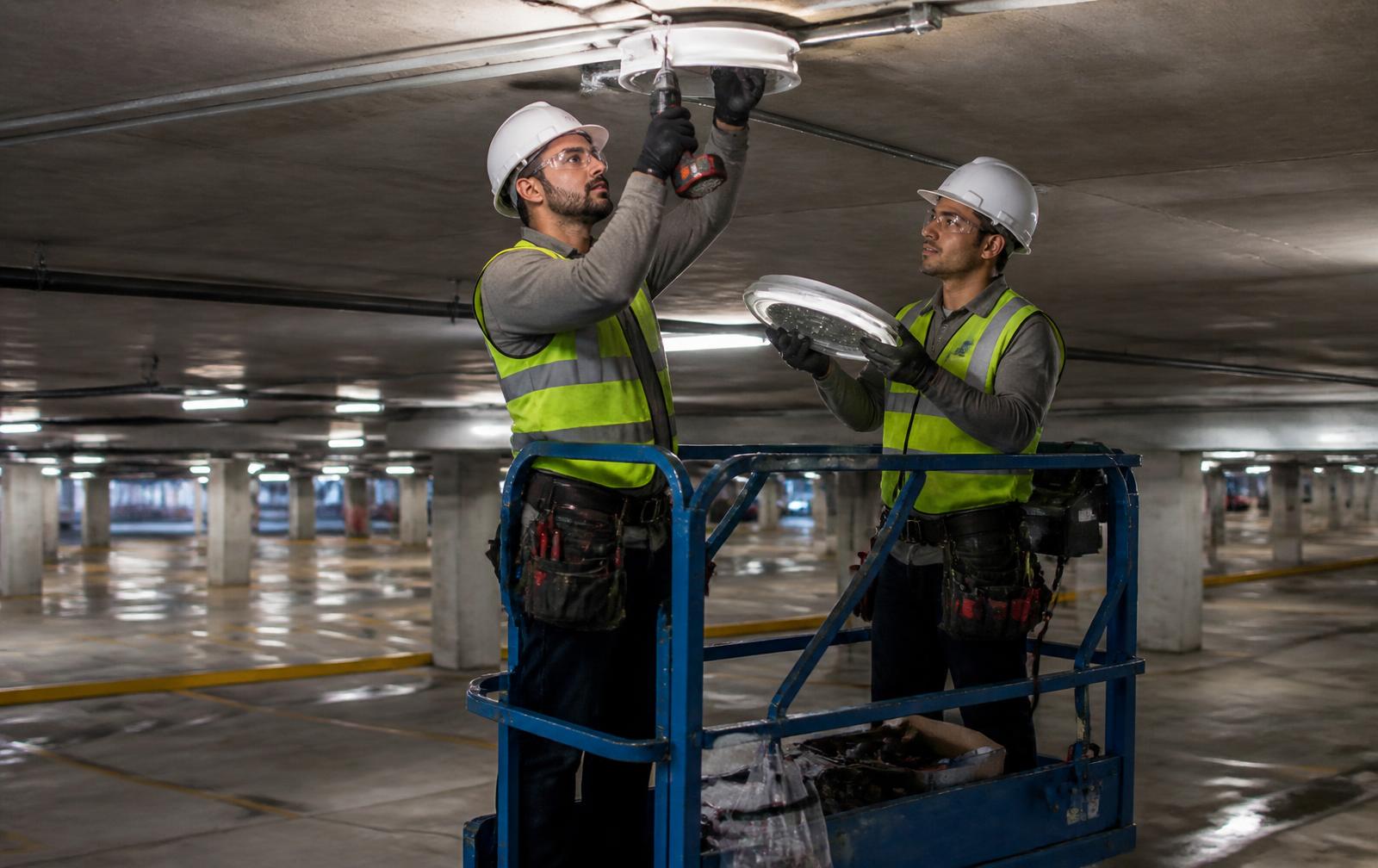
Why lighting is priced per fixture, not per hour
Almost every other kind of electrical work is priced by scope because every scope is different. Lighting is the exception. Once a crew has set up on a floor, confirmed the circuit, and replaced the first three or four fixtures, the remaining fixtures are close to identical. That repeatability is exactly what makes unit pricing work, and it is why serious lighting contractors quote a rate per light instead of an open-ended hourly estimate.
Unit pricing protects the buyer. You know the number before the crew arrives, you can approve a partial scope, and you can add or remove fixtures without renegotiating the contract. If the count changes from 380 to 412 on install day, the invoice moves by 32 units and nothing else. There is no argument about how long a ladder move should have taken.
It also protects the schedule. A retrofit quoted at a fixed rate per fixture gives everyone a shared production target, so a building manager can tell tenants which floors are getting done on which nights instead of guessing.
What per-fixture pricing typically looks like
For straightforward commercial LED replacement in an accessible T-bar ceiling at standard height, unit rates in Metro Vancouver commonly land in the range of $120 to $175 per fixture supplied and installed as labour, with the fixture cost handled separately or bundled depending on the program. On a 400-fixture building at $150 per light with a crew replacing roughly five per hour, the math is transparent to both sides before anyone opens a box.
Residential works the same way at a smaller scale. A homeowner who has just bought a house and purchased 12 new fixtures for us to install is looking at a defined unit price per light rather than an unpredictable day rate, and the whole job is typically a half day of work. Retrofit pot lights in an existing ceiling, exterior wall packs, parkade fixtures, and one-for-one bathroom exhaust fan swaps in multi-unit buildings all price cleanly the same way.
The variables that move the rate are height and access, whether the ceiling is drywall or T-bar, whether existing housings can be reused or need to be cut in, whether new controls or occupancy sensors are part of the scope, and whether work has to happen after hours around tenants or operations.
Where large-scale lighting projects come from
The biggest volumes we see in the Lower Mainland come from strata corporations doing common-area, corridor, and parkade upgrades; property managers standardizing lighting across a portfolio; commercial landlords preparing space for a new tenant; and utility or government funded efficiency programs where the incentive is calculated per measure and per fixture. Programs like BC Hydro's commercial energy efficiency channel are built around exactly this kind of countable, verifiable measure.
Funded and budgeted work behaves differently from out-of-pocket work. When the decision maker is a facilities manager, a strata council working from a depreciation report, or a program administrator, the conversation is about schedule, documentation, and disruption rather than about shaving a few dollars off a line item. That is the right environment for a quality retrofit, and it is the work we build our lighting crews around.
Single-family projects belong in the same category when the homeowner has already bought the fixtures and simply needs a licensed crew to install them properly, safely, and in one visit.
What a well-run retrofit actually includes
A fixture count and sample install before the full order is placed, so everyone confirms fit, colour temperature, and beam spread on the real ceiling instead of on a spec sheet. Getting 2700K versus 4000K wrong across 400 fixtures is an expensive mistake that a single sample prevents.
A permit where the scope requires one, licensed electricians on site, proper circuit identification and lockout, drop cloths and clean-up on every floor, and disposal or recycling of the removed fixtures and any ballasts or lamps containing mercury.
Documentation at closeout: final fixture counts by floor and type, model and serial records where a rebate or warranty depends on them, control commissioning notes, and a punch walk with the property manager before the last invoice.
For occupied buildings, a night or weekend schedule that keeps corridors and parkades usable. We would rather work around your tenants than have your tenants work around us.
Get a per-fixture quote for your building or home
Electric Hero prices lighting retrofits per fixture across Vancouver, Burnaby, Richmond, Surrey, Coquitlam, Port Coquitlam, New Westminster, North Vancouver, Langley, and Delta, and we travel for larger projects in Squamish, Whistler, and the Gulf Islands when the scope justifies the trip.
Send us a fixture count, a photo of a typical ceiling, and the fixture you plan to use, and we will come back with a unit rate, a realistic production schedule, and a total. If you have not selected fixtures yet, we will spec options at two or three price points so the budget conversation happens before the order, not after.
Call 604-779-HERO (4376) or email web@electrichero.ca to book a lighting walkthrough.
Talk to a Certified BC Master Electrician
Every quote is a fixed price, every job is pulled under permit, and every visit is on time. Serving Vancouver, Burnaby, Richmond, Coquitlam, Port Coquitlam, North Vancouver, Langley, and Delta.