Solar & Storage
Solar Panel Installation Costs in Vancouver: 2026 Guide to Prices, Rebates, and Payback
A straight-talking 2026 breakdown of what residential solar actually costs in Vancouver, which rebates and loans still apply, how BC Hydro net metering credits work, and how long payback really takes on a Metro Vancouver roof.
What solar panels cost in Vancouver in 2026
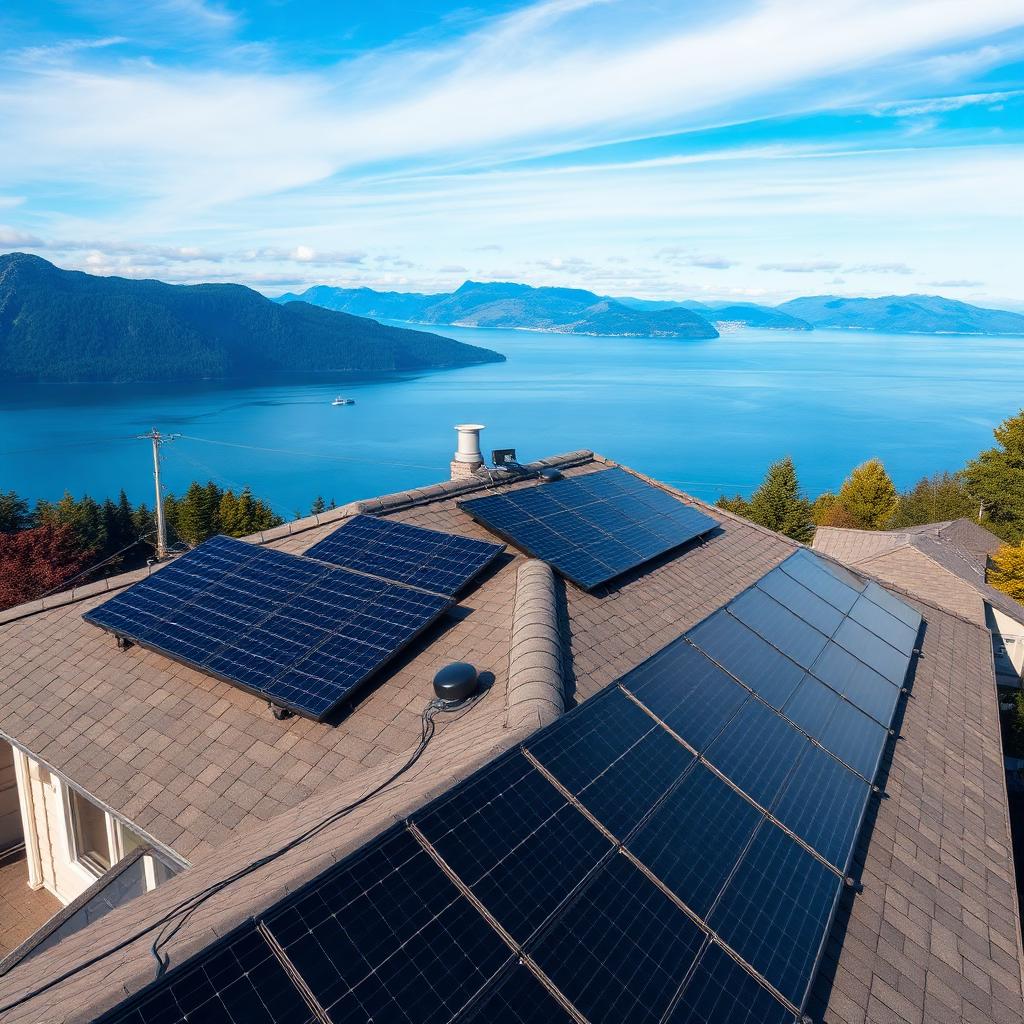
For a standard grid-tied residential system on a Vancouver, Burnaby, Richmond, or Coquitlam home, installed pricing in 2026 typically lands between $2.75 and $3.75 per installed watt, all-in. That covers Tier 1 panels, string or micro-inverters, racking rated for our wind and snow loads, roof penetrations and flashing, DC and AC wiring, an AC disconnect, a production meter, the electrical permit, the Technical Safety BC inspection, and the BC Hydro interconnection paperwork.
In real numbers, a typical 6 kW system on a Metro Vancouver home costs roughly $17,000 to $22,000 before rebates. A larger 10 kW system sized for an EV plus a heat pump usually runs $28,000 to $37,000. Battery storage is separate: a 10 kWh home battery installed with a critical-loads sub-panel typically adds $14,000 to $18,000.
Pricing swings based on roof complexity, whether we need a service panel upgrade to accommodate the interconnection, and whether the array is a single plane or spread across multiple orientations. Older Vancouver homes with 60A or 100A service almost always need a panel upgrade before solar, which we quote as a separate line item so the solar cost stays honest.
Rebates and loans that actually apply in 2026
The federal Canada Greener Homes Grant is closed to new applicants, but the interest-free Canada Greener Homes Loan is still active for eligible homeowners. It funds up to $40,000 over 10 years at 0% interest for solar, batteries, heat pumps, and insulation - the single biggest financial lever on a Metro Vancouver solar project. Most homeowners going solar in 2026 finance through this loan and use BC Hydro net metering credits to service the payment.
CleanBC and BC Hydro rebates for residential solar itself are limited - BC Hydro does not offer a direct per-watt solar rebate. What they do offer is net metering, plus rebates on the electrification loads that make solar worthwhile: heat pumps, heat pump water heaters, and EV chargers. Stacking a heat pump rebate with a Greener Homes Loan-funded solar array is the most common Vancouver playbook.
GST applies to residential solar in BC. PST is exempt on qualifying solar equipment. Any installer quoting a rebate that sounds too generous should be asked to name the exact program - if they cannot, it is not real.
How BC Hydro net metering credits work
Under BC Hydro's net metering program, every kilowatt-hour your array exports to the grid earns a credit at the retail rate on your bill. Credits accumulate month to month and are trued up annually on your anniversary date. If you have surplus credits at true-up, BC Hydro pays them out at a lower wholesale rate - which is why we size arrays to your annual consumption plus a modest EV or heat pump load, not larger.
BC residential electricity is cheap by North American standards, so a kilowatt-hour of solar in Vancouver is worth less than the same kilowatt-hour in California or Ontario. That is the single biggest reason solar payback in Metro Vancouver is longer than the headline numbers you see in national coverage.
Realistic payback period for a Metro Vancouver home
On a well-oriented, unshaded south-facing roof in Vancouver, Burnaby, Richmond, or North Vancouver, a modern 6-10 kW array produces roughly 1,100 to 1,200 kWh per installed kilowatt per year. That translates to a simple payback of 12 to 16 years for a cash-purchased system at current BC Hydro rates, and a shorter effective payback when the project is financed through the Canada Greener Homes Loan because the loan payment is offset by utility bill savings from day one.
Payback shortens when you pair solar with electrification: a heat pump replacing gas heat, a Level 2 EV charger replacing gasoline, or a shift away from a gas water heater. Payback lengthens with heavy tree shading, north or steep-east/west roof planes, or if a panel upgrade is required to interconnect.
We build the payback math into every solar quote we send - actual production estimate based on your roof, actual BC Hydro rate schedule, actual loan terms if you finance - so you can decide with real numbers instead of brochure numbers.
When solar makes sense in Metro Vancouver, and when it does not
Solar makes sense on a Vancouver-area home when the roof is south, southeast, or southwest facing, is under 20 years old or was recently reroofed, has minimal shading between 10 am and 3 pm, and the household is already electrifying transportation and heating. In those cases the array pays back inside its warranty and delivers 15+ years of near-free electricity after payback.
Solar does not make sense yet if the roof needs replacement within 5 years, if the home has heavy tree shading that cannot be pruned, or if the household is planning to move within 3 years and cannot capture the payback. In those cases we usually recommend a panel upgrade, a heat pump, and a Level 2 EV charger first, then revisit solar after the roof or shading situation changes.
Get an honest solar quote for your Metro Vancouver home
Electric Hero designs, permits, installs, and services residential solar and battery systems across Vancouver, Burnaby, Richmond, Coquitlam, Port Coquitlam, North Vancouver, Langley, and Delta. Every quote includes a real production estimate, real rebate and loan math, and a fixed price that covers permits and inspection - not a teaser number that grows on installation day. Call 604-779-HERO (4376) or book online at electrichero.ca to schedule a site assessment.
References
Talk to a Certified BC Master Electrician
Every quote is a fixed price, every job is pulled under permit, and every visit is on time. Serving Vancouver, Burnaby, Richmond, Coquitlam, Port Coquitlam, North Vancouver, Langley, and Delta.